- Call Us +91 9860428052 | +91 9096092960
- Mail at info@taskgauges.in
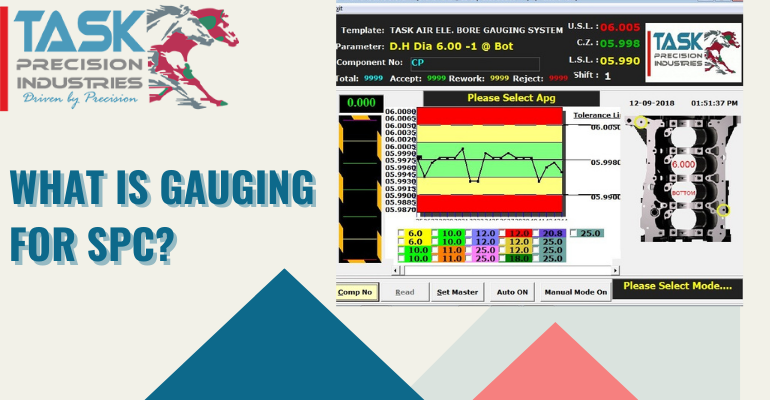
What is Gauging For SPC?
SPC plays a significant part in assisting you in enhancing the quality of your products and is a priceless tool for optimizing company processes to ultimately increase productivity and profitability. It includes all the software necessary to improve the calibre and reliability of your output. Web-based analysis can be used to make decisions about the quality of your products in real time.
Characteristic Gauges for SPC must have specific order to do the work at hand. These consist of:
● Being able to generate varied data To identify even the smallest changes in a process, SPC needs resolution. As long as other requirements are satisfied,the greater a Gauge resolution , the better. GO/NO-GO gauges typically do not offer the kind of measurement data required for SPC.
● Repetition and reproduction (R&R). SPC calls for accuracy. A gauge should consistently produce the same reading when used to test the same component across time. A different person ought to be able to replicate those outcomes as well. Error brought on by a lack of gauge R&R lowers confidence in the data and the capacity to choose parts wisely. All human engineering, or "ergonomics," used to create a gauge, including how it is held, where a part is placed, and the training required, must show consideration for good R&R.
● Efficiency. Large data sets are needed for SPC. This necessitates a gauge that can successfully be used repeatedly and generates data quickly.
● Assistance for statistical analysis A gauge is essentially a serial device that produces one piece of data at a time, whereas SPC operates on groups of data. In order for data to be collected and organized, a gauge must also facilitate data collecting by offering data in a consistent format.
The employed gauges should have electronic data output for best efficiency. Regardless of whether a gauge includes LCD digits, columns of lights, mechanical pointers, a huge display, or a little one, a gauge without an electronic data output still has to be read. The gauge becomes susceptible to human mistake if it needs to be read by someone. This is due to the fact that any gauge has the potential for inaccurate reading, interpretation, or recording of the reading. Direct electronic output to a data collector eliminates this potential for human error.
A gauge with an electronic output accelerates data processing and measurement. The person taking the measurements can focus on getting accurate readings, and the person collecting the data can group the serial stream of numbers into data for analysis.
Nowadays, the majority of gauges have electronic outputs that can be connected to data collectors for data recording and analysis. Several common gauge outputs, including serial BCD, serial ASCII, serial binary, and RS-232C, have been created. Analog outputs at standard voltage levels are available on several column gauges and metrology displays.
Data Collector from Gauge
The SPC process can be viewed as a collection of interconnected subsystems, each of which serves a specific function:
● The first subsystem, gauging, has little intelligence but outputs data and has a digital readout.
● The second subsystem, the data collector, is utilized at the source to record data in a computer-readable format and to give the operator feedback. This input may be sent immediately to a process controller like a PLC or SLC in some unattended data collection procedures.
● A third component, called SPC analysis software, is utilized to conduct analysis, produce graphs on a CRT, and create hardcopy reports.
You can more easily determine which type of specialization belongs by dividing the data collection system into subsystems. For instance, Buying gauges with built-in statistical analysis software would be unnecessary if a data collector with integrated statistical analysis software is utilized at a station with numerous gauges. All you need in this situation are gauges that can output data. The majority of electronic data collectors concentrate some intelligence specifically, SPC software in the data collectors themselves.
Benefits of Spc Software
More feedback than any one gauge could offer, the data collector provides the operator with the necessary feedback during the procedure. An operator may receive guidance from this input regarding the appropriate gauge to use and the dimensions to measure.
Each gauge reading is evaluated against reasonable limits and part specifications by the data collector, who also evaluates subgroups against control limits. If something is incorrect, the collector then notifies the operator.
A data collector draws charts on derived variables like total indicator readings (TIR), minimums, and maximums while simultaneously performing mathematical operations on many gauge inputs.
When a process is mostly unattended, data are collected on-site and analyzed off-site. This is often done in a quality control department on a desktop computer. An alternative would be to use a handheld data collector equipped with SPC software at the process location.
Computer to Data Collector
An essential link to a third kind of subsystem, computer software for SPC, is a data collector. Despite the fact that most SPC work is really done at the process level, most choices that have an impact on the process are made at the plant level.
Smart data is necessary for good decisions. An SPC data gathering system that provides management with information helps to concentrate efforts on the major issues (the Pareto principle). Additionally, SPC software is a useful tool for evaluating capability, scrap, rework, and cost of quality and offers a standard vocabulary for discussing issues that arise at each step.
Software for PCs is now part of most data collection systems. Some, such as those offered by DataMyte, maintain an open architecture. Many commercial software vendors have developed interfaces to these open-architecture systems. Use of these interfaces allows SPC users to choose from among many valuable features for data analysis and reporting, and to maintain SPC databases on a variety of different computers. In addition, most SPC software programs now provide their own open-architecture databases.
Task Industries is a leading SPC Software provider in india . The task precision industry is a leading gauging manufacturer in India . We at Task Precision , Manufacture gauges at Affordable Prices , including universal gauges, multi parameter gauges, automation gauges, air/standard gauges, and many more. All of these gauges provide precise data and analytics that will enable you to achieve the best results.