- Call Us +91 9860428052 | +91 9096092960
- Mail at info@taskgauges.in
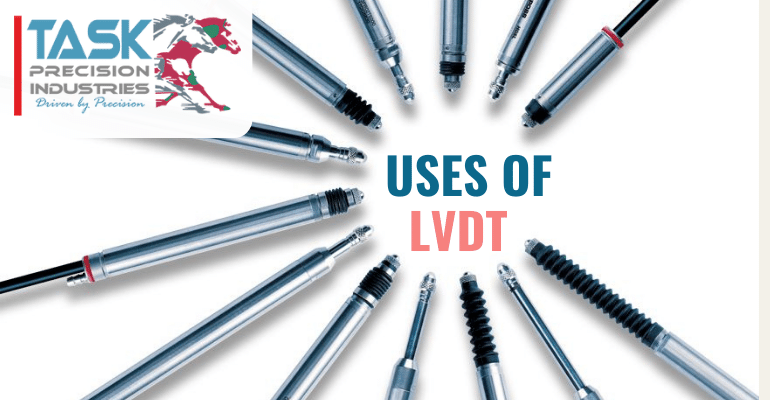
What Is The Use Of LVDT ?
Friction-Free Operation
An linear variable differential transformer LVDT's frictionless operation is one of its key characteristics. There is no rubbing, dragging, or other cause of friction when the LVDT's core and coil assembly are not in mechanical contact. High resolution dimensions, gauging systems, vibration displacement measurements, and materials testing all benefit greatly from this feature.
Infinite Resolution
An LVDT can sense infinitesimally tiny changes in core position because it uses electromagnetic coupling principles in a construction free of friction. Only the noise in an LVDT signal conditioner and the output display's resolution can prevent this technology from having infinite resolution. The exceptional repeatability of an LVDT is also a result of these same characteristics.
Unlimited Mechanical Life
No parts can rub against one another or wear out because the LVDT's core and coil construction are typically not in contact. This indicates that an LVDT has an endless mechanical life. This component is particularly significant in high reliability applications like nuclear plants, satellites, and aircraft. It is also highly desired in many systems for factory automation and industrial process control.
Overtravel Damage Resistant
Most LVDTs have an interior bore that is open on both ends. The sensor coil assembly can be entirely traversed by the core in the event of unexpected overtravel without suffering any harm. An LVDT is a suitable sensor for applications like extensometers that are attached to tensile test samples in destructive materials testing equipment due to its resistance to position input overload.
Single Axis Sensitivity
An LVDT responds to core movement along the axis of the coil, but is typically insensitive to core movement cross-axis or to core position. As a result, applications involving misaligned or floating moving members as well as scenarios where the core does not travel in a perfectly straight line can typically be used for an LVDT without experiencing any negative effects.
Separable Coil And Core
The coil assembly can be separated from the core by inserting a non-magnetic tube between the core and the bore of an LVDT because the only connection between the coil and core of an LVDT is magnetic coupling. By doing this, a pressurized fluid can be kept inside the tube while the coil assembly is kept at room pressure. The core is then free to move. This function is frequently employed in LVDTs for hydraulic proportional and/or servo valve spool position feedback.
Environmentally Robust
An LVDT is a sturdy, long-lasting sensor that can withstand a range of climatic conditions because of the materials and construction methods employed in its assembly. Following the bonding of the windings, epoxy is used to encapsulate them in the casing, providing them with better resistance to moisture and humidity as well as the capacity to withstand heavy shock loads and high vibration levels in all directions. Furthermore, the inbuilt high-permeability magnetic barrier reduces the impact of outside AC fields. The cover serves as an additional magnetic shield, and the core is composed of corrosion-resistant metals as well. Additionally, for applications where the sensor must function in pressurized fluid or endure exposure to combustible or harmful gasses and liquids. Several welding techniques can be used to hermetically seal the case and coil assembly. Ordinary LVDTs have a fairly wide operating temperature range, but they can also be manufactured to work at cryogenic temperatures or, with the use of special materials, at the high temperatures and radiation levels present in many nuclear reactors, if necessary.
Null Point Repeatability
The location of an LVDT's intrinsic null point is extremely stable and repeatable, even over its very wide operating temperature range. This makes an LVDT perform well as a null position sensor in closed-loop control systems and high-performance servo balance instruments.
Fast Dynamic Response
An LVDT may react to changes in core position very quickly because there is no friction present during normal operation. The only factor limiting an LVDT sensor's dynamic response is the core's small amount of inertial mass. The properties of the signal conditioner are more frequently what dictate how an LVDT sensing system responds.
Absolute Output
As contrast to an incremental output device, an LVDT is an absolute output device. As a result, the position data being provided from the LVDT will not be lost in the event of a power outage. The output value of the LVDT will be the same as it was prior to the power outage when the measurement system is resumed.
Task gauges is a leading LVDT Manufacturer in India. We provide high quality gauging products